Tuna Cold Storage: Temperature, Cold Room Requirements & Best Practices
tuna cold storage requirements
Tuna Cold Storage: Temperature, Cold Room Requirements & Best Practices
Tuna is a high-value seafood product that requires reliable temperature control throughout the entire cold chain. From harvesting and processing to transportation and final storage, maintaining the right temperature is essential for protecting product quality, extending shelf life and reducing losses.
For tuna processors, seafood distributors, importers, cold chain logistics companies and foodservice suppliers, a properly designed tuna cold storage facility is an important part of an efficient seafood supply chain.
1. Why Does Tuna Need Professional Cold Storage?
Tuna is sensitive to temperature fluctuations, particularly after harvesting and processing. If the product is not cooled or frozen quickly enough, quality can deteriorate and storage life may be reduced.
A professionally designed tuna cold room can help businesses:
Maintain stable low-temperature conditions
Extend the storage life of frozen tuna
Reduce quality losses caused by temperature fluctuations
Minimize dehydration and freezer burn
Improve inventory management
Support food safety and cold chain requirements
For seafood exporters, reliable cold storage is especially important because tuna may travel long distances by sea, road and air before reaching the final market.
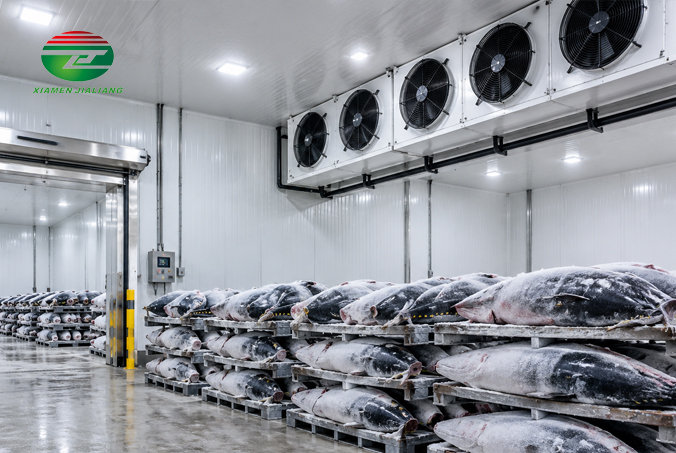
2. What Is the Recommended Tuna Storage Temperature?
The appropriate storage temperature depends on the type of tuna product, processing method, packaging, required storage period and applicable food safety standards.
Frozen Tuna Storage
For long-term frozen tuna storage, commercial freezer rooms commonly operate at temperatures such as -18°C, -25°C, -30°C or lower, depending on the product and application.
Higher-value tuna products, including export-grade whole tuna and tuna loins, may require lower storage temperatures to maintain specific quality requirements.
Ultra-Low Temperature Tuna Storage
Some premium tuna products are stored at ultra-low temperatures, with systems designed to operate at approximately -40°C, -50°C or below.
Ultra-low temperature cold rooms require careful engineering of the refrigeration system, insulation panels, doors, electrical controls and monitoring systems.
The target temperature should therefore not be considered in isolation. A proper tuna cold storage design should also consider:
1.Cold room volume
2.Product entering temperature
3.Daily loading capacity
4.Packaging method
5.Required storage period
6.Ambient temperature
7.Door opening frequency
8.Required temperature recovery time
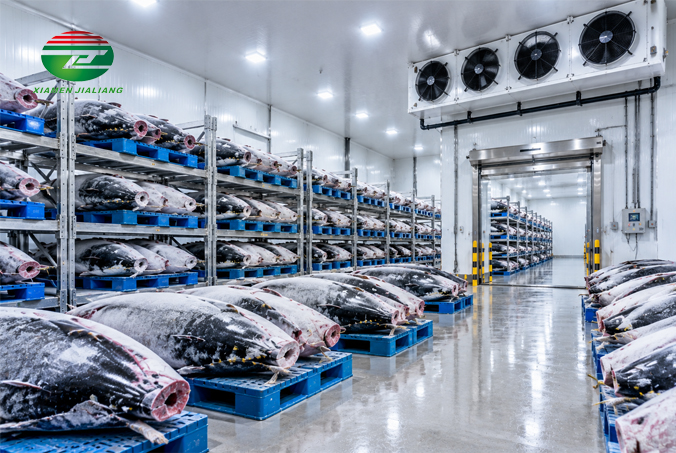
3. What Should Be Considered When Designing Tuna Cold Storage?
Before designing a tuna freezer room, the actual operating requirements should be clearly defined.
Storage Capacity
Cold storage capacity depends not only on floor area but also on packaging, pallet dimensions, rack configuration and aisle requirements.
For example, two 500-square-meter cold rooms can have significantly different storage capacities depending on the racking and stacking system used.
Product Entering Temperature
The temperature of the tuna when it enters the cold room directly affects the refrigeration load.
If the tuna has already been frozen, the freezer room mainly needs to maintain the required storage temperature.
If the tuna must be frozen inside the facility, a dedicated blast freezer or rapid freezing system may be required.
These are two different refrigeration applications and should not be designed in the same way.
Daily Loading Volume
The amount of tuna entering the facility each day is one of the most important design parameters.
For a processing plant handling dozens or even hundreds of tons per day, compressor capacity, evaporator selection, condenser capacity and electrical requirements should all be calculated according to the actual refrigeration load.
Ambient Conditions
Climate conditions vary significantly between countries and regions.
In tropical and subtropical areas, high summer ambient temperatures increase the heat load on the cold room and may raise condensing temperatures. The refrigeration system should therefore be properly selected for local conditions.
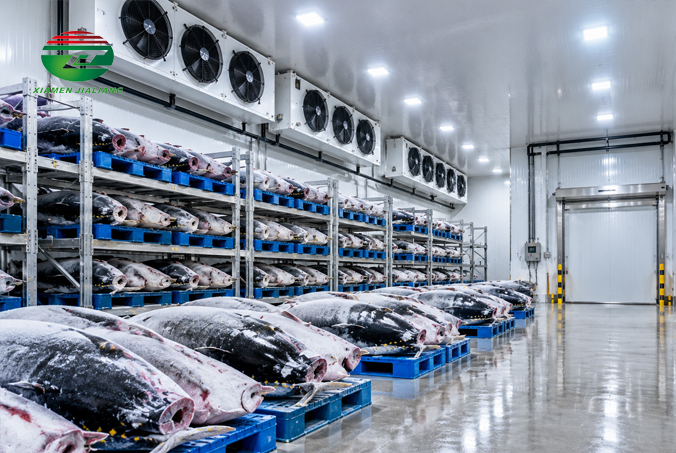
4. Tuna Freezer Room vs. Blast Freezer: What Is the Difference?
When planning a seafood cold chain, it is important to distinguish between freezing and frozen storage.
A freezer room is mainly designed to maintain the low temperature of products that have already been frozen.
A blast freezer, on the other hand, is designed to rapidly reduce product temperature and freeze the product within a relatively short period.
A complete tuna cold chain may include:
Processing → Pre-Cooling → Blast Freezing → Frozen Storage → Cold Storage Loading → Refrigerated Transportation
Each stage has different temperature requirements and refrigeration loads. A properly engineered project may therefore require different refrigeration systems for different processes.
Conclusion
A professional tuna cold storage facility should be designed according to the tuna product type, target storage temperature, storage capacity, incoming product temperature, daily loading volume, local climate and operating conditions.
There is no single cold storage configuration that is suitable for every tuna project.
If you are planning a tuna cold room, frozen seafood warehouse or complete seafood cold chain project, it is recommended to provide the following basic information before starting the design:
Product type + target storage temperature + storage capacity + daily incoming volume + product entering temperature + project country/city
Based on these parameters, the appropriate cold room dimensions, refrigeration capacity, insulation structure and equipment configuration can be determined.
Looking for a customized tuna cold storage solution? Contact our refrigeration engineering team to discuss your project requirements.
www.coldroomjl.com